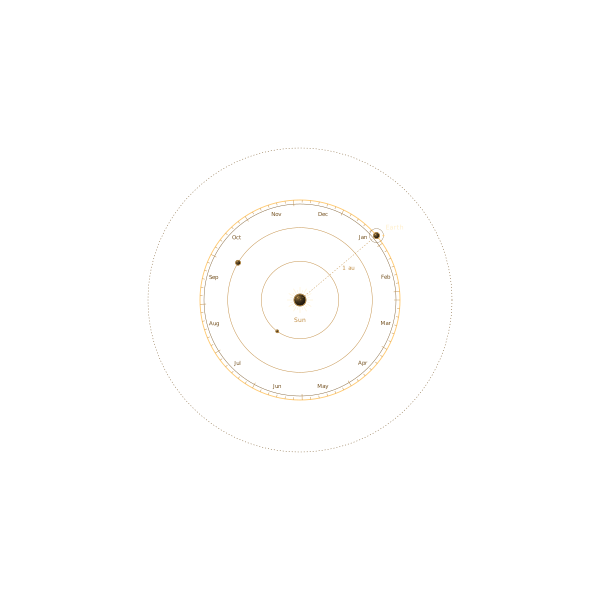
Earth's orbit
Each year Earth travels about 940 million kilometres around this loop, moving at roughly thirty kilometres every second.
Earth orbits the Sun at an average distance of one astronomical unit, fixed in 2012 at exactly 149,597,870,700 metres. The orbit is therefore about 299 million km, or 2 AU, across. It is very nearly a circle: Earth is closest to the Sun in early January, at about 147 million km, and farthest in early July, at about 152 million km.
That small difference is not what causes the seasons; northern winter falls when Earth is nearest the Sun. Seasons come from the 23.4° tilt of Earth's axis, which turns each hemisphere towards the Sun for half the year and away for the other half.
Measuring the astronomical unit was one of the great problems of early astronomy. In the eighteenth century, expeditions including James Cook's first voyage to Tahiti in 1769 timed transits of Venus across the Sun's face from distant points on Earth to work it out by triangulation. Today radar and spacecraft tracking measure distances in the solar system to within metres.
Moving at about 29.8 km/s, Earth covers its own diameter in roughly seven minutes. The orbit of Neptune, the next stop, is about thirty times wider than Earth's.
- Size
- 2.99 × 10¹¹ m
- Astronomical unit
- 149,597,870.7 km
- Orbital speed
- about 29.8 km/s
- Period
- 365.256 days