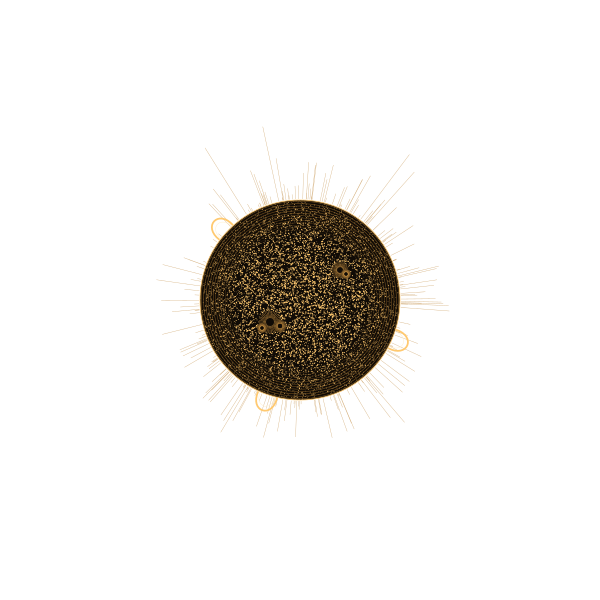
The Sun
A ball of hot plasma wide enough to line up 109 Earths, whose light reaches you about eight minutes after it leaves.
The Sun is about 1.39 million km across, 109 times the width of Earth and almost exactly ten times that of Jupiter. It holds 99.86% of all the mass in the solar system, and about 1.3 million Earths would fit inside it by volume.
In its core, at about 15 million °C, the Sun fuses roughly 600 million tonnes of hydrogen into helium every second, turning about 4 million tonnes of matter into energy. That energy takes tens of thousands of years or more to work its way out through the dense interior, then crosses to Earth in just over eight minutes.
The visible surface, the photosphere, is about 5,500 °C, yet the thin outer atmosphere, the corona, reaches more than a million degrees. Why is still being studied by spacecraft such as NASA's Parker Solar Probe, which in December 2024 passed about 6 million km above the surface, closer than any human-made object before it.
For all its size, the Sun is a fairly ordinary star: a yellow dwarf about 4.6 billion years old and roughly halfway through its stable life. The orbit of Earth, the next stop, is about 215 times wider than the Sun itself.
- Size
- 1.39 × 10⁹ m
- Mass
- 1.99 × 10³⁰ kg
- Surface temperature
- about 5,500 °C
- Age
- about 4.6 billion years