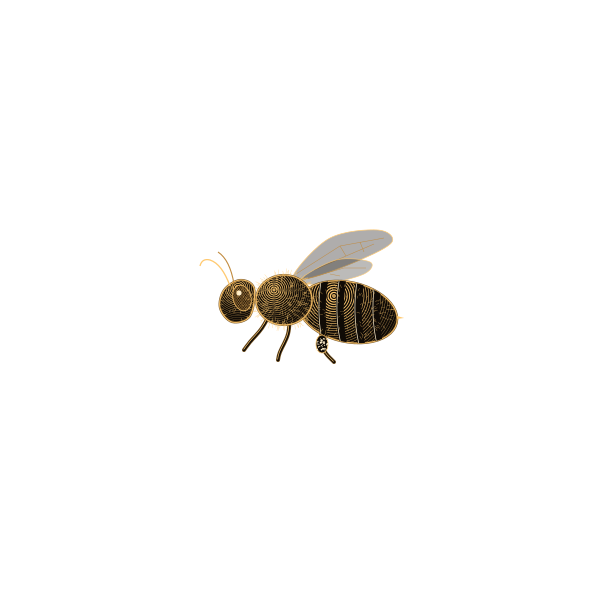
Honeybee
A worker beats its wings about 230 times a second and dances to tell its sisters where the flowers are.
Workers of the western honeybee, Apis mellifera, are about 12 to 15 millimetres long, three times the length of a garden ant, and weigh roughly a tenth of a gram. Queens are longer, around 20 millimetres, while drones are stockier, with huge eyes that meet at the top of the head. Laid end to end, about 110 workers would match your height.
A strong colony in summer holds some 20,000 to 60,000 workers, nearly all of them sterile females. A worker lives only five or six weeks in the busy season, and in her whole life makes about a twelfth of a teaspoon of honey. A widely quoted estimate is that half a kilogram of honey takes about 80,000 kilometres of flying, twice around the Earth.
Foragers share directions with the waggle dance, decoded by Karl von Frisch, who shared a Nobel Prize in 1973. On the vertical comb, the angle of the dance gives the direction of the food relative to the Sun, and the length of each waggle run tells the distance.
Bees see ultraviolet light, which reveals landing-strip patterns on petals invisible to us, but they cannot see red, which looks dark to them. Their wingbeat, about 230 times a second, produces the familiar hum.
- Size
- 1.5 × 10⁻² m
- Worker mass
- about 0.1 g
- Colony size
- 20,000–60,000
- Wingbeat
- about 230 per second