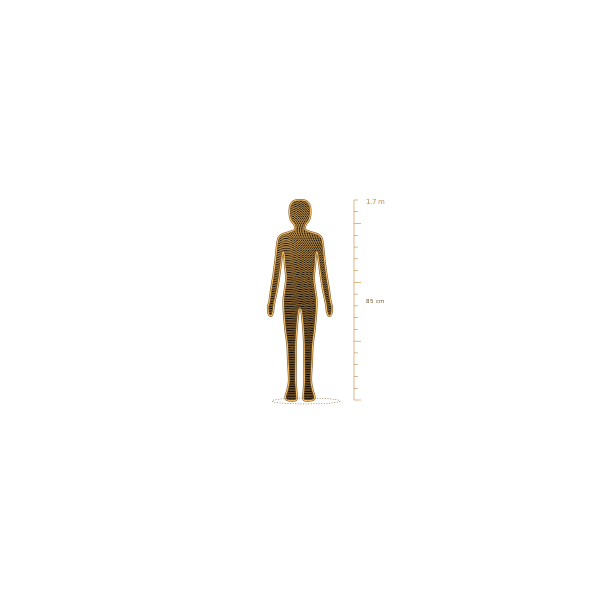
You
You are about a hundred honeybees tall, and roughly 7 × 10²⁷ atoms make up your body, two thirds of them hydrogen.
The 1.7 metres used here is a round figure close to the average adult height worldwide, which is about 1.71 m for men and 1.59 m for women. Measured in the units of the scale below, you are about 24,000 human hairs side by side, or some 1,700 sand grains end to end.
Your body holds roughly 30 to 37 trillion human cells, most of them red blood cells, and about as many bacteria, mainly in your gut, among them a modest population of E. coli. Your atoms number about 7 × 10²⁷, and around two thirds of them are hydrogen, most of it made in the first minutes after the Big Bang.
Your height is not fixed. You are about a centimetre taller in the morning than at night, because the discs in your spine compress under gravity during the day. Astronauts on the International Space Station grow by up to about 3% while weightless, and shrink back on their return.
Your size has its own physics. Much smaller, and a warm-blooded body loses heat too quickly; much larger, and bones must thicken out of proportion to carry the weight. That is the limit that keeps land animals in check, and the one the blue whale, the next stop, escapes by living in water.
- Size
- 1.7 × 10⁰ m
- Atoms in your body
- about 7 × 10²⁷
- Human cells
- about 30–37 trillion
- Adult height (world)
- about 1.59–1.71 m