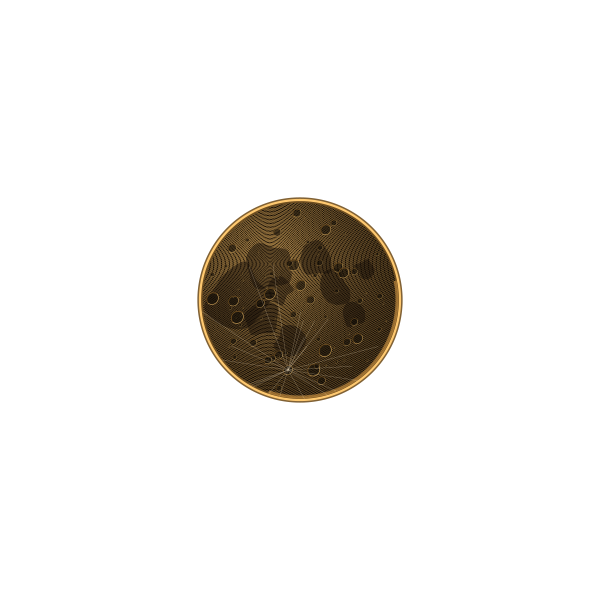
The Moon
A little over a quarter the width of Earth, and slowly drifting away from us by about 3.8 centimetres every year.
The Moon is 3,474.8 km across, a little over a quarter of Earth's diameter and slightly less than the width of Australia. Some 390 Mount Everests would fit across it side by side.
Most scientists think it formed about 4.5 billion years ago, when a body roughly the size of Mars, sometimes called Theia, struck the young Earth and threw debris into orbit that gathered into the Moon. Rocks brought back by the Apollo astronauts are chemically very similar to Earth's mantle, one of the key clues.
The Moon is tidally locked: it turns once on its axis for every orbit, so the same face always points towards us. Its gravity raises the ocean tides, and the friction of those tides is slowly braking Earth's spin and pushing the Moon outward by about 3.8 centimetres a year. That figure comes from timing laser pulses bounced off reflectors left on the surface by Apollo crews.
The average distance between Earth and Moon is 384,400 km, enough room to line up about thirty Earths. Light crosses it in about 1.3 seconds. Earth, the next stop, is about 3.7 times wider than the Moon and some 81 times more massive.
- Size
- 3.47 × 10⁶ m
- Mass
- 7.35 × 10²² kg
- Mean distance
- 384,400 km
- Surface gravity
- 1.62 m/s² (about 1/6 g)