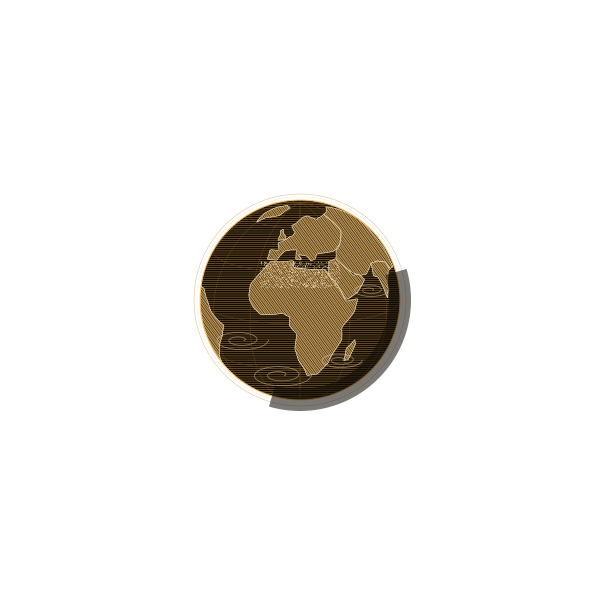
Earth
A rocky ball spinning at about 1,670 km/h at the equator, wrapped in an atmosphere whose densest layer is only about twelve kilometres deep.
Earth's mean diameter is 12,742 km, but it is not a perfect sphere. Its spin flattens it slightly, so the equatorial diameter is about 43 km greater than the distance from pole to pole. A point on the equator is carried round at about 1,670 km/h.
It is the densest planet in the solar system, about 5.5 times as dense as water, thanks to its core of iron and nickel. The inner core is solid despite temperatures comparable with the surface of the Sun, and is about 2,440 km across, roughly 70% of the width of the Moon.
Seventy-one per cent of the surface is ocean, with an average depth of about 3.7 km. Yet all of Earth's water, gathered into a single ball, would be only about 1,385 km across, some 40% of the Moon's width. The layer of air that holds nearly all our weather, the troposphere, is on average about twelve kilometres deep, under a thousandth of the planet's width.
Earth's circumference was first estimated about 2,200 years ago by Eratosthenes, who compared the angles of shadows at Syene and Alexandria. Jupiter, the next stop, is about eleven Earths wide and could hold some 1,300 Earths by volume.
- Size
- 1.27 × 10⁷ m
- Mass
- 5.97 × 10²⁴ kg
- Equatorial diameter
- 12,756 km
- Surface covered by ocean
- about 71%