Quark
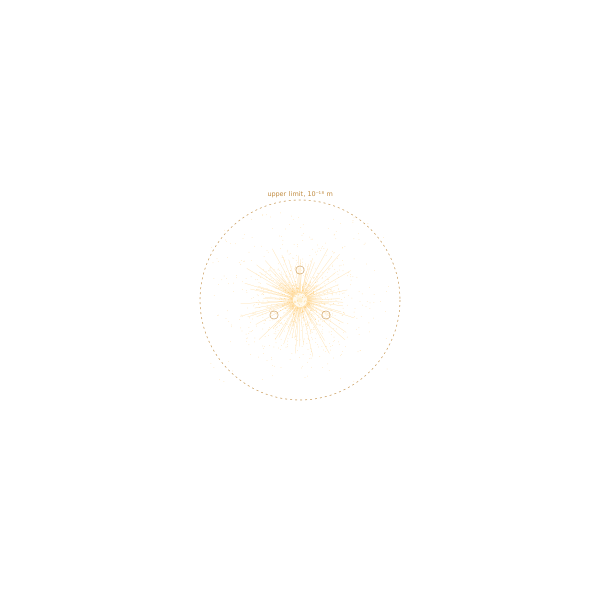
No edge has ever been found: at every resolution our colliders reach, the quark still behaves like a point.
Quarks are the building blocks of protons and neutrons, yet none has ever had its size measured. Experiments at the Large Hadron Collider and the HERA collider in Hamburg have probed matter down to about 10⁻¹⁸ m, roughly a thousandth of a proton's width, and found no hint of inner structure. The figure here is a ceiling, not a measurement: if quarks have a size at all, it is smaller than this.
They also refuse to be seen alone. The strong force between two quarks grows stronger as they are pulled apart, like a rubber band that never snaps. Put enough energy into the band and it makes a new quark and antiquark pair instead of breaking, so every quark ever detected has arrived bundled inside a larger particle. Physicists call this confinement.
There are six kinds, or flavours: up, down, charm, strange, top and bottom. Ordinary matter needs only two. A proton is two up quarks and one down; a neutron is two downs and one up. Their electric charges come in thirds, +2/3 and −1/3, which add up neatly to the whole numbers measured for protons and neutrons.
Oddly, the quarks themselves supply only about 1% of a proton's mass. The rest is the energy of the gluons that bind them and of their restless motion, a working example of E = mc² inside every atom of your body.
- Size
- 1 × 10⁻¹⁸ m
- Flavours
- 6
- Charge (up / down)
- +2/3 e, −1/3 e
- Up quark mass
- about 2.2 MeV/c²