Proton
A hundred thousand times smaller than its own atom, yet it carries almost all of that atom's weight.
The proton is the whole nucleus of a hydrogen atom and a part of every other nucleus. Its charge radius is about 0.84 femtometres (a femtometre is 10⁻¹⁵ m), which gives a diameter of roughly 1.7 × 10⁻¹⁵ m. Sixty billion protons laid side by side would just span the thickness of a sheet of paper.
That radius caused a decade of argument. In 2010, measurements using muonic hydrogen, in which a heavy muon replaces the electron, gave about 0.84 fm, noticeably smaller than the 0.88 fm from older methods. The so-called proton radius puzzle has largely settled on the smaller value, but it showed how hard it is to measure something with no hard surface.
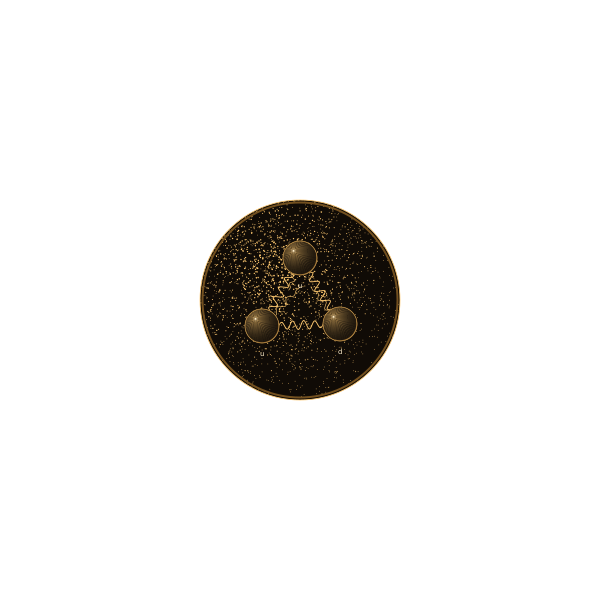
A proton is not a little ball. It is a cloud of three quarks and a swarm of gluons and short-lived quark pairs, with a fuzzy boundary defined by how its charge is spread. Compared with the quark below it on this scale, it is at least a thousand times wider; compared with the uranium nucleus above, it is one brick in a building of 238.
Protons are also remarkably durable. Japan's Super-Kamiokande detector has watched 50,000 tonnes of ultra-pure water for decades without seeing a single one decay, which puts the proton's lifetime above about 10³⁴ years, far longer than the age of the universe.
- Size
- 1.7 × 10⁻¹⁵ m
- Mass
- 1.673 × 10⁻²⁷ kg
- Charge radius
- about 0.84 fm
- Charge
- +1 e