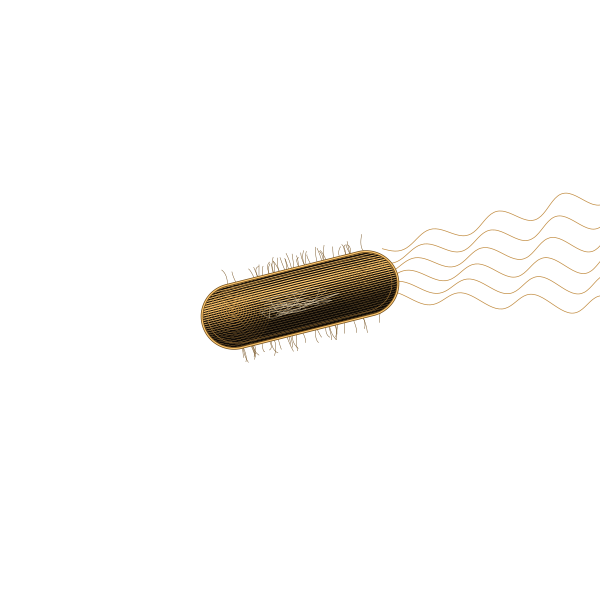
E. coli bacterium
A rod two micrometres long that can, given warmth and sugar, divide in two every twenty minutes.
Escherichia coli is a rod-shaped bacterium about 2 micrometres long and half a micrometre wide. Five hundred of them end to end would span one millimetre, and each holds roughly a femtolitre, a millionth of a billionth of a litre.
Most strains are harmless and live in the intestines of warm-blooded animals, including yours, where they help keep harmful microbes in check. A few strains, such as O157:H7, carry toxin genes and cause serious food poisoning.
E. coli is also the workhorse of biology. In ideal laboratory conditions it doubles in about 20 minutes, so a single cell could in principle become sixteen million within eight hours. Studies of it revealed how genes are switched on and off, and since the early 1980s engineered E. coli has produced human insulin for people with diabetes.
It swims using several whip-like flagella, each turned by a rotary motor at its base that can spin more than a hundred times a second, one of the few true wheels in nature. Measured against its neighbours, it is about twenty times longer than a flu virus, and roughly four of them would lie across a single red blood cell.
- Size
- 2 × 10⁻⁶ m
- Size
- about 2 × 0.5 µm
- Doubling time
- about 20 min (ideal)
- Genome
- about 4.6 million bp