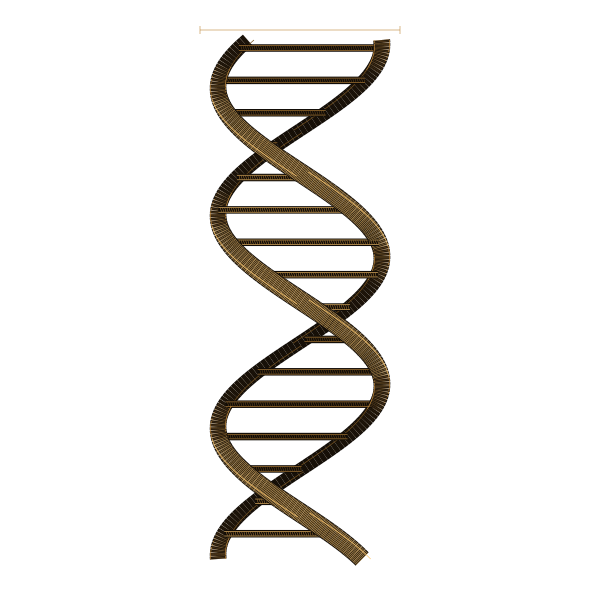
DNA double helix
Only two nanometres wide, yet the strands in a single human cell would stretch about two metres if pulled straight.
DNA is a ladder twisted into a spiral. Its sides are chains of sugar and phosphate; its rungs are pairs of bases, adenine with thymine and guanine with cytosine. The helix is about 2 nanometres wide, the width of seven water molecules side by side, and makes one full turn every 10.5 base pairs, roughly every 3.4 nanometres.
The length is the surprise. A typical human cell holds about 6.4 billion base pairs spread over 46 chromosomes, around two metres of DNA, packed into a nucleus only about six micrometres across. It fits by winding around protein spools called histones, then coiling and folding again, rather like packing 40 kilometres of fine thread into a tennis ball.
The double helix was described in 1953 by James Watson and Francis Crick, who relied heavily on X-ray images made by Rosalind Franklin and Raymond Gosling at King's College London, above all the famous Photo 51.
The width is the same in every living thing: a bacterium's DNA, a whale's and yours are all 2 nanometres across. What differs is the sequence and the length. The single circular chromosome of the E. coli bacterium, a little further up this scale, is about 1.6 millimetres long, folded into a cell nearly a thousand times shorter.
- Size
- 2 × 10⁻⁹ m
- Helix width
- about 2 nm
- Rise per base pair
- 0.34 nm
- Human genome
- about 3.1 billion bp