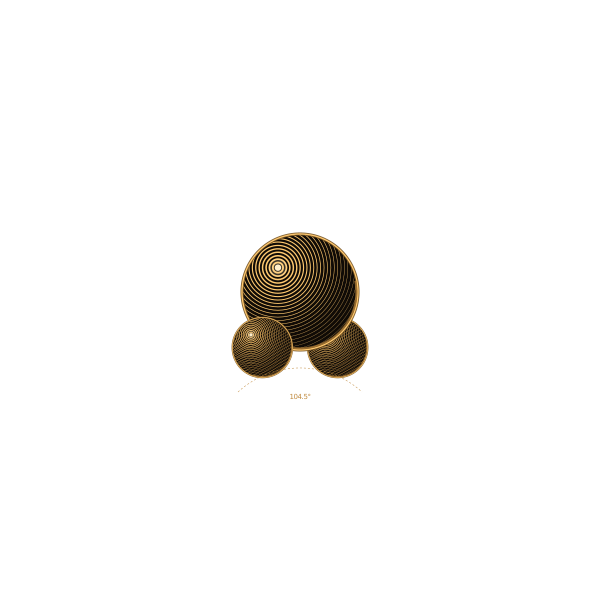
Water molecule
Three atoms bent at an angle of 104.5 degrees, and that small kink is why oceans, ice and life behave as they do.
A water molecule is one oxygen atom bonded to two hydrogens, about 0.28 nanometres across: less than three hydrogen atoms in width. The two bonds meet at an angle of about 104.5 degrees, so the molecule is bent like a boomerang rather than straight.
That bend matters. Oxygen pulls the shared electrons towards itself, leaving its end of the molecule slightly negative and the hydrogen ends slightly positive. Neighbouring molecules cling to each other through these charges in hydrogen bonds. They are why water is a liquid at room temperature, while hydrogen sulphide, a heavier molecule of the same shape, is a gas.
Hydrogen bonds also explain why ice floats. As water freezes, its molecules lock into an open hexagonal lattice that takes up about 9% more room than the liquid, so ice is less dense than the water beneath it. Lakes therefore freeze from the top down, and the ice insulates the life below.
The numbers are vast even in small amounts. A 250 ml glass of water holds about 8 × 10²⁴ molecules, more than most estimates of the number of stars in the observable universe. Lined up end to end, the molecules from that one glass would reach far beyond the orbit of Neptune.
- Size
- 2.8 × 10⁻¹⁰ m
- Formula
- H₂O
- Bond angle
- about 104.5°
- Molar mass
- 18.02 g/mol