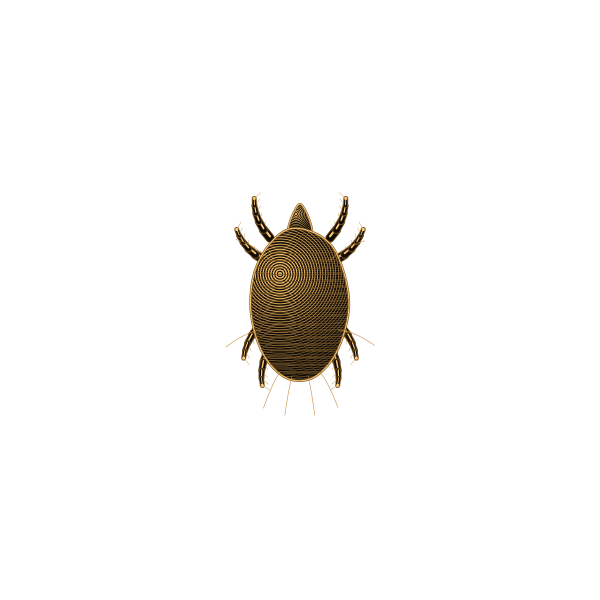
Dust mite
An eight-legged relative of spiders, too small to see clearly, living by the thousand in bedding and feeding on shed skin.
The house dust mite, Dermatophagoides pteronyssinus and its close relatives, is an arachnid about a quarter to a third of a millimetre long. Adults have eight legs, no eyes and a pale, translucent body. At this size a mite sits right at the edge of visibility: on a dark surface it might be glimpsed as a moving speck.
Dust mites feed on the flakes of skin that people and pets shed constantly. They do not drink; instead they absorb moisture from humid air, which is why they thrive in mattresses, pillows, carpets and soft furnishings and struggle in dry climates or at high altitude.
They do not bite. The trouble lies in their droppings, which contain digestive proteins such as one called Der p 1 that can trigger asthma, eczema and hay-fever-like symptoms. House dust mites are among the most common causes of indoor allergy worldwide, and a single used mattress may hold thousands of them.
A dust mite is about four hair-widths long, or some forty red blood cells end to end. A grain of sand, the next stop, is about three times its length: to the mite, a boulder.
- Size
- 3 × 10⁻⁴ m
- Class
- Arachnida
- Legs (adult)
- 8
- Lifespan
- about 2–3 months