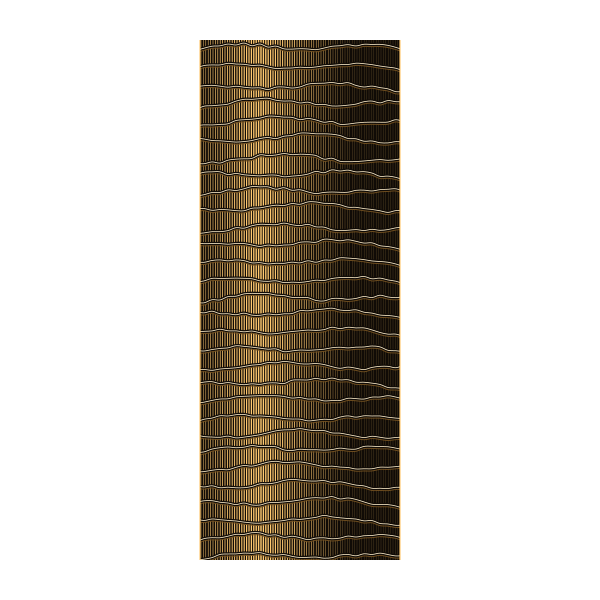
Human hair
Close to the limit of what the naked eye can pick out, and covered in overlapping scales like the tiles on a roof.
A human hair is usually somewhere between 50 and 100 micrometres thick, with a typical figure of about 70; individual hairs range from under 20 to over 150 micrometres depending on the person and the part of the head. The unaided eye can just resolve about 0.1 millimetre at reading distance, so a single hair is visible mostly because it is long.
Under a microscope the surface is a cuticle of flat, overlapping dead cells arranged like roof tiles, all pointing towards the tip. Beneath lies the cortex, bundles of keratin fibres that give the hair its strength and hold the pigment melanin, and in thicker hairs a soft central core called the medulla.
Hair is strong for its size. A single strand can hold around 100 grams before breaking, so the hundred thousand or so hairs on a typical scalp could in principle support several tonnes. Scalp hair grows about a centimetre a month.
The width of a hair is a handy ruler for the scale below it. About ten red blood cells fit across it, or some 35 E. coli laid end to end. Four or five hairs side by side match the length of a house dust mite, the next stop.
- Size
- 7 × 10⁻⁵ m
- Typical width
- about 50–100 µm
- Growth rate
- about 1 cm per month
- Main protein
- Keratin