Jupiter
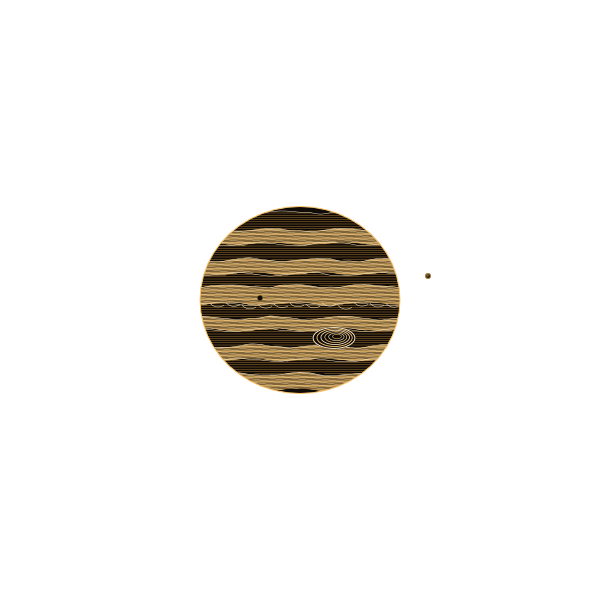
Eleven Earths would fit across its face, where a single storm wider than our planet has been watched for nearly two centuries.
Jupiter is 139,820 km across at the equator, the largest planet in the solar system. Its mass is about 318 times Earth's and more than twice that of all the other planets combined. It spins faster than any other planet, once every 9 hours 56 minutes, quickly enough to bulge visibly: it is about 6.5% wider at the equator than from pole to pole.
It has no solid surface. What we see are bands of ammonia clouds in an atmosphere of mostly hydrogen and helium, which grows hotter and denser with depth until the hydrogen behaves like a liquid metal. NASA's Juno spacecraft, in orbit since 2016, found that the core is not a compact ball but a diluted, fuzzy region mixed into the layers around it.
The Great Red Spot is a storm wider than Earth that has been tracked continuously since the 1830s. It has been shrinking, from about 40,000 km long in the late 1800s to around 16,000 km today.
Jupiter has nearly a hundred known moons, among them Ganymede, the largest moon in the solar system and wider than the planet Mercury. Massive as it is, Jupiter would need about 80 times more mass to ignite fusion and become a star. The Sun, the next stop, is almost exactly ten Jupiters wide.
- Size
- 1.4 × 10⁸ m
- Mass
- about 318 Earths
- Day length
- 9 h 56 min
- Distance from Sun
- about 5.2 AU