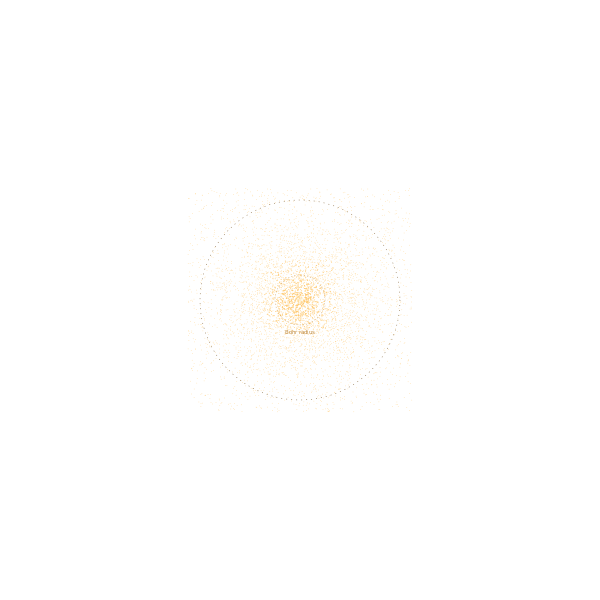
Hydrogen atom
One proton, one electron, and a cloud of probability about sixty thousand times wider than the nucleus at its centre.
Hydrogen is the simplest atom: a single proton accompanied, in the loose quantum sense, by a single electron. It has no sharp edge. The electron exists as a cloud of probability, most likely to be found at the Bohr radius of 5.29 × 10⁻¹¹ m, so a working diameter is about 1.06 × 10⁻¹⁰ m, roughly one ångström or a tenth of a nanometre.
The emptiness is the striking part. The atom is about 60,000 times wider than its proton. Enlarge the proton to a marble one centimetre across and the atom around it would be 600 metres wide, nearly twice the height of the Eiffel Tower, with the electron the only other occupant.
Hydrogen is also the most common element in the universe. About three quarters of all ordinary matter by mass is hydrogen, almost all of it made in the first few minutes after the Big Bang. Every star, including the Sun further up this scale, shines by fusing it into helium.
The electron can sit only at certain energy levels. When it drops from one to another it gives off light at precise wavelengths, such as the deep red line at 656 nanometres that colours glowing gas clouds like the Orion Nebula. That fingerprint lets astronomers detect hydrogen across billions of light years.
- Size
- 1.06 × 10⁻¹⁰ m
- Bohr radius
- 5.29 × 10⁻¹¹ m
- Mass
- 1.674 × 10⁻²⁷ kg
- Ionisation energy
- 13.6 eV