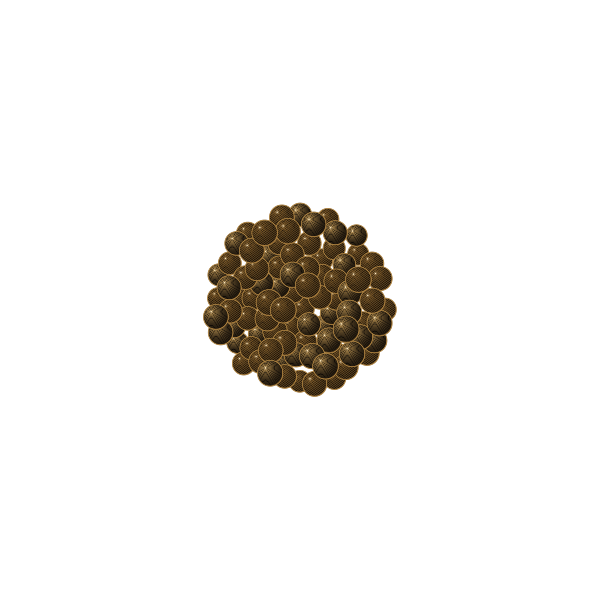
Uranium nucleus
Two hundred and thirty-eight particles packed so tightly that a teaspoon of this matter would weigh about a billion tonnes.
Uranium-238, the commonest form of uranium, packs 92 protons and 146 neutrons into a nucleus about 15 femtometres across, roughly nine times the width of a single proton. Nuclei grow slowly as they gain particles: the radius rises only with the cube root of the count, because the protons and neutrons pack together like marbles in a bag rather than forming a hollow shell.
The packing is extreme. Nuclear matter has a density of about 2 × 10¹⁷ kg per cubic metre, much the same in almost every nucleus, so a teaspoon of it would weigh around a billion tonnes. The only places matter like this exists in bulk are neutron stars.
Uranium sits near the edge of stability. Its 92 protons all repel one another electrically, and the strong force only just holds them together. U-238 has a half-life of about 4.5 billion years, close to the age of the Earth, so roughly half the uranium the planet was born with is still here. Its lighter sibling U-235 splits when struck by a slow neutron, releasing about 200 MeV and two or three fresh neutrons: the principle behind every nuclear reactor.
Even so, the nucleus is a speck within its own atom. If a uranium atom were enlarged to the size of a football stadium, its nucleus would be a pea on the centre spot.
- Size
- 1.5 × 10⁻¹⁴ m
- Protons
- 92
- Neutrons (U-238)
- 146
- Half-life (U-238)
- 4.47 billion years