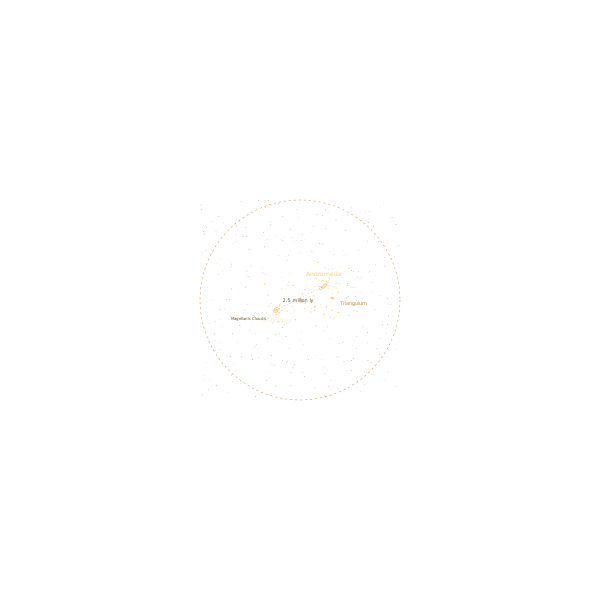
Local Group
More than eighty galaxies bound together by gravity, ruled by two giant spirals that are falling slowly towards each other.
The Local Group is the small cluster of galaxies the Milky Way belongs to, around 10 million light years across, roughly a hundred times the width of our galaxy. It contains more than 80 known galaxies, most of them faint dwarfs, and new ones are still being found in deep surveys.
Two members dominate: the Milky Way and the Andromeda Galaxy (M31), about 2.5 million light years away. Andromeda is the most distant object most people can see with the naked eye. The third largest member is the Triangulum Galaxy (M33). Smaller satellites, such as the Large and Small Magellanic Clouds, orbit our own galaxy and are easy to see from the Southern Hemisphere.
Andromeda is approaching at about 110 km/s. Earlier studies predicted a collision in about 4.5 billion years; a 2025 analysis using data from the Gaia and Hubble telescopes put the chance of a merger within the next 10 billion years at about one in two. Even if the galaxies do merge, their stars are so widely spaced that almost none would actually collide.
The Local Group is itself a minor outpost on the edge of the much larger Laniakea Supercluster, the next stop, which is about fifty times wider.
- Size
- 9.5 × 10²² m
- Members
- more than 80 galaxies
- Largest member
- Andromeda (M31)
- Distance to M31
- about 2.5 million ly